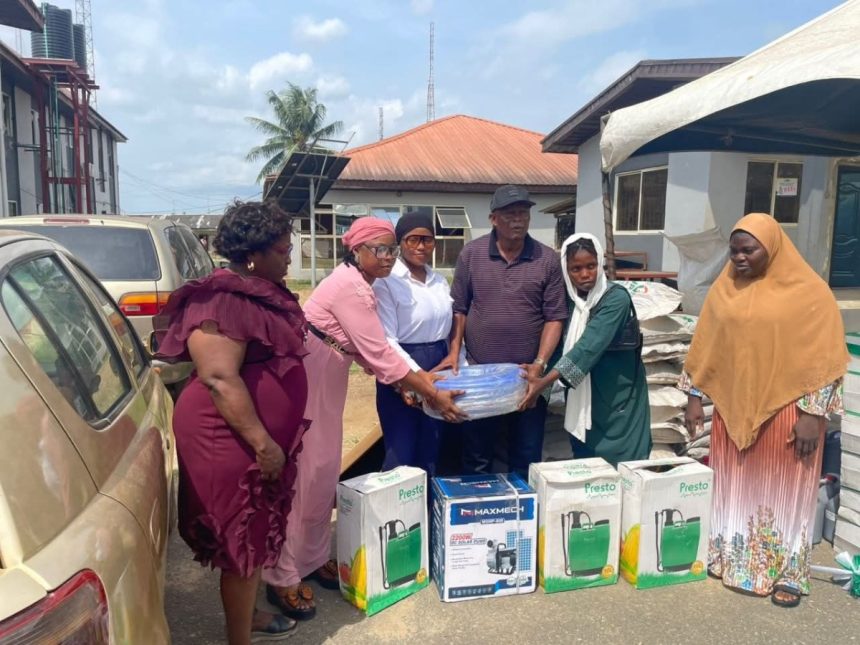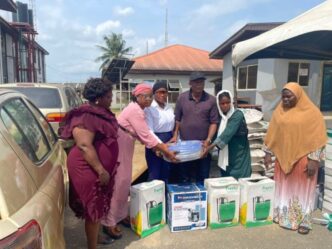
Thirty-five women farmers across Epe Division have been empowered with modern agricultural tools and inputs to boost productivity and income.
Epe Insights reports that the initiative, supported by the International Centre for Environmental Health and Development and the African Women Development Fund, targets women farmers and youths in the division.
beneficiaries came from Epe Central, Agbowa, Ikosi, Ejinrin, Ehin-Osa, Ladaba, and participants in the Agric YES programme in Eredo LCDA. Distributed items included organic compost manure, liquid manure, Nacers spray, hand sprayers, 14 solar panels, pumping machines, smoking canes, ewedu seeds, and ugu vegetable seeds.
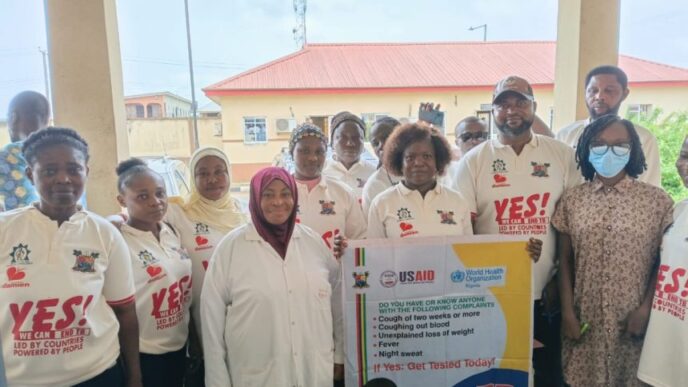
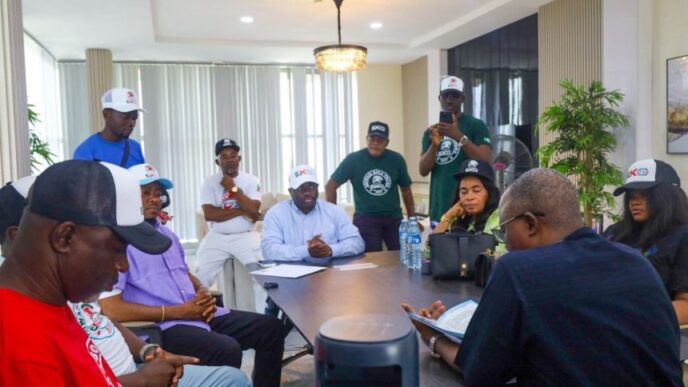
The empowerment programme followed a two-day intensive training held at Iju-Ishaga, Lagos, equipping participants with modern farming techniques to enhance productivity. The training emphasised sustainable practices and efficient use of agricultural inputs.
Aminat Shabi, President of Farmers in Epe Local Government and ICEHD Coordinator, commended the organizations for their consistent support. She noted that since 2022, ICEHD has empowered women farmers with inputs and training, significantly improving productivity in the division.
She highlighted the importance of solar-powered equipment in addressing irrigation and power challenges due to the unstable electricity supply in Epe. Pumping machines will aid farm irrigation, while smoking canes will assist fish processors in preserving their catch.
Shabi expressed gratitude to stakeholders, including the Executive Chairman of Epe Local Government, Surah Olayemi Animashaun, the Vice Chairman, Hon. Sikiru Owolomoshe, and supporting organizations for their contribution to agricultural development in the area.
The initiative is expected to strengthen food production, empower rural women, and promote sustainable farming practices across Epe Division. Beneficiaries anticipate increased efficiency, higher yields, and improved income levels.
Officials stated that such empowerment programmes are critical for fostering agricultural growth, especially for women who play key roles in rural food production and household livelihoods.
The combination of training and modern inputs is seen as a model for sustainable agricultural development. Stakeholders hope that the programme will inspire more initiatives that address local challenges such as irrigation, electricity shortages, and access to quality farming resources.
This intervention reflects a broader commitment to rural development and women’s empowerment, highlighting the role of modern farming techniques in enhancing productivity and resilience in Epe’s agricultural sector.