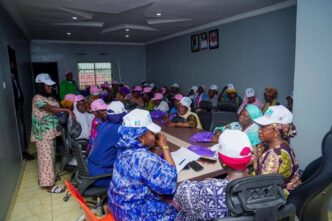

Engr. Rasaki Bamidele Kasali, MNSE, MNATE, was present at the Council Secretariat to coordinate environmental sanitation activities within the premises.
Epe Insights reports that Kasali’s participation reflected the administration’s emphasis on practising environmental responsibility within government facilities while encouraging residents to maintain clean surroundings in their communities.
The sanitation exercise focused on the Council Secretariat, ensuring that the premises where official government activities take place also received proper environmental attention.
Kasali coordinated the exercise and ensured that sanitation activities were carried out across the designated areas of the Secretariat.
The exercise highlighted the importance of maintaining clean and orderly government facilities.
The Chairman maintained that environmental responsibility should begin with the institutions responsible for promoting it across the communities.
According to the administration, it would make little sense to encourage residents to maintain clean environments while neglecting the surroundings where governance and public service are carried out.
The position underscores the need for government facilities to serve as examples of proper environmental management.
A clean Council Secretariat provides a more conducive environment for staff, visitors and residents who come to access government services.
It also reinforces the message that environmental cleanliness is a shared responsibility.

The sanitation exercise provided an opportunity to clean and organise areas within the Secretariat while drawing attention to the importance of regular environmental maintenance.
Kasali’s presence also demonstrated the administration’s commitment to ensuring that sanitation directives are supported by practical action.
Rather than limiting environmental responsibility to public announcements, the administration emphasised the importance of leading by example.
The exercise is part of the broader effort to promote better environmental practices within the Council area.
Government facilities are frequently visited by residents seeking various public services, making their cleanliness an important aspect of effective administration.
A well-maintained Secretariat can also contribute to a positive public perception of the local government.
The administration therefore stressed that environmental sanitation should remain a continuous practice.
Staff and other users of the facility were encouraged to take responsibility for keeping their immediate surroundings clean.
Proper waste disposal was also identified as an important part of maintaining the Secretariat and other public spaces.

The administration urged people to avoid practices that could undermine sanitation efforts.
Kasali’s coordination of the exercise further demonstrated the role of public officials in supporting environmental initiatives.
His involvement ensured that attention was given to the Secretariat alongside other areas where sanitation activities are being promoted.
The Chairman’s position also reflects a broader principle of responsible governance.
According to the administration, government should demonstrate the standards it expects from residents and communities.
This approach can encourage greater public participation in environmental programmes.
When government facilities are properly maintained, residents can more easily appreciate the importance of similar practices in their homes, businesses and communities.
The sanitation exercise therefore served both a practical and symbolic purpose.
Practically, it helped improve the condition of the Council Secretariat.
Symbolically, it reinforced the message that environmental responsibility must begin from within government institutions.

The administration said maintaining clean public facilities would remain an important part of its environmental efforts.
It also encouraged staff members to sustain the cleanliness achieved during the exercise.
Residents visiting the Secretariat were similarly encouraged to support efforts to maintain a clean and orderly environment.
The initiative further highlights the connection between environmental cleanliness and effective public service.
A clean workplace can contribute to a more comfortable environment for employees while creating a better experience for members of the public.
Kasali’s presence at the Secretariat was therefore viewed as an important part of ensuring that environmental responsibility was demonstrated through action.
The administration expressed its commitment to continuing initiatives that promote cleanliness across government facilities and surrounding communities.
It also called for cooperation from residents, staff, community leaders and other stakeholders.
Environmental sanitation, according to the administration, cannot be sustained through government efforts alone.
Individuals and communities must also adopt responsible practices in their daily activities.
The Chairman’s message was clear that government institutions must lead by example.
The Council Secretariat, as a centre of public administration, should reflect the same environmental standards being encouraged across the wider community.
The sanitation exercise consequently provided an opportunity to reinforce that commitment.

Kasali coordinated the activities while ensuring that the Secretariat remained part of the administration’s broader environmental sanitation efforts.
The exercise also demonstrated the value of consistent attention to public facilities.
Regular cleaning and responsible waste management can help preserve government infrastructure and maintain a suitable environment for public service.
The administration encouraged all stakeholders to sustain the spirit of cooperation demonstrated during the exercise.
It urged staff and residents to view environmental cleanliness as an everyday responsibility rather than an occasional activity.
The Chairman further appreciated the efforts of those who participated in the sanitation exercise.
He encouraged them to continue supporting initiatives designed to improve environmental conditions across the Council area.
The administration believes that clean government facilities can strengthen public confidence and reinforce the importance of responsible environmental behaviour.
By taking sanitation activities to the Council Secretariat, the administration demonstrated that the responsibility to maintain a clean environment applies equally to government and the communities it serves.
The exercise ultimately reinforced the principle that effective environmental leadership begins with practical example.
As sanitation efforts continue, the Council leadership urged everyone to play a role in maintaining clean, healthy and orderly surroundings.